- How anthropomorphic design blurs the line between tech and emotion, and why your brain instantly feels something for lifelike digital motion.
- The secret psychology behind emotional UX — how soft animations, flow-like motion, and familiar human rhythms make users trust interfaces more.
- What “digital biophilia” really means and how nature-inspired design (yes, even jellyfish-style motion!) calms the nervous system and keeps users engaged.
- How designers use anthropomorphic imagery to create empathy, connection, and personality in websites, AI, and apps.
- Why lifelike motion can shape emotion, and how understanding the mind behind it can change how you see every interface you touch.
Somewhere beneath the still blue of the South China Sea, a ghost drifts through the water. It’s not a creature — not really — but the illusion of one. Developed at Northwestern Polytechnical University in Xi’an, Shaanxi, this bionic jellyfish robot (nicknamed the underwater ghost, 水下幽灵) moves with eerie grace, its translucent body pulsing like something alive.
Using electro-hydraulic muscle actuators and flexible hydrogel electrodes, this jellyfish glides through water almost silently, consuming only ~28.5 milliwatts as it moves. It doesn’t sting, it doesn’t think, but it feels real.
Professor Kai Tao and his team, who also created a 470-kg manta ray robot that swims, have made biomimicry their signature. Their designs imitate life so well that our brains hesitate — is it alive, or is it pretending?
And that’s where the real psychology begins.
Because somewhere between machine and motion, between “mechanical” and “alive,” our emotions get tangled.
Why do we feel something for a jellyfish made of silicone and code?
Anthropomorphism — Our Habit of Seeing Life Everywhere
Humans are emotional mirrors — we see ourselves reflected in almost everything.
That’s anthropomorphic design, the psychological tendency to assign human emotions, traits, or intentions to nonhuman things. It’s why we name our cars, yell at printers, or feel bad for a Roomba stuck under the couch.
This instinct isn’t random — it’s survival wiring. For early humans, spotting signs of life (like a rustling bush or shifting shadow) was the difference between safety and danger. Our brains evolved to detect agency — to assume something is alive until proven otherwise.
In the digital age, that instinct hasn’t vanished. It’s just found new objects to love.
Think of Tamagotchis, chatbots, Siri, or even AI pets — tiny emotional traps designed to trigger empathy.
Even the smallest UI detail can carry a “personality.” UX pioneer Don Norman once wrote:
“Everything has a personality: everything sends an emotional signal. Even where this was not the intention of the designer, people who view the website infer personalities and experience emotions.”
From friendly loading animations to chatbots that say “hey there!” — every design choice whispers emotion, whether we mean it to or not.
Psychology Behind Anthropomorphic Design — When Emotion Meets Design
Emotion isn’t just the glitter on top of experience — it is the experience.
People don’t engage with logic first; they engage with feeling.
A warm-toned interface feels “friendly.” A soft motion feels “safe.” Sharp, jittery animations? Your brain quietly translates that as “danger.”
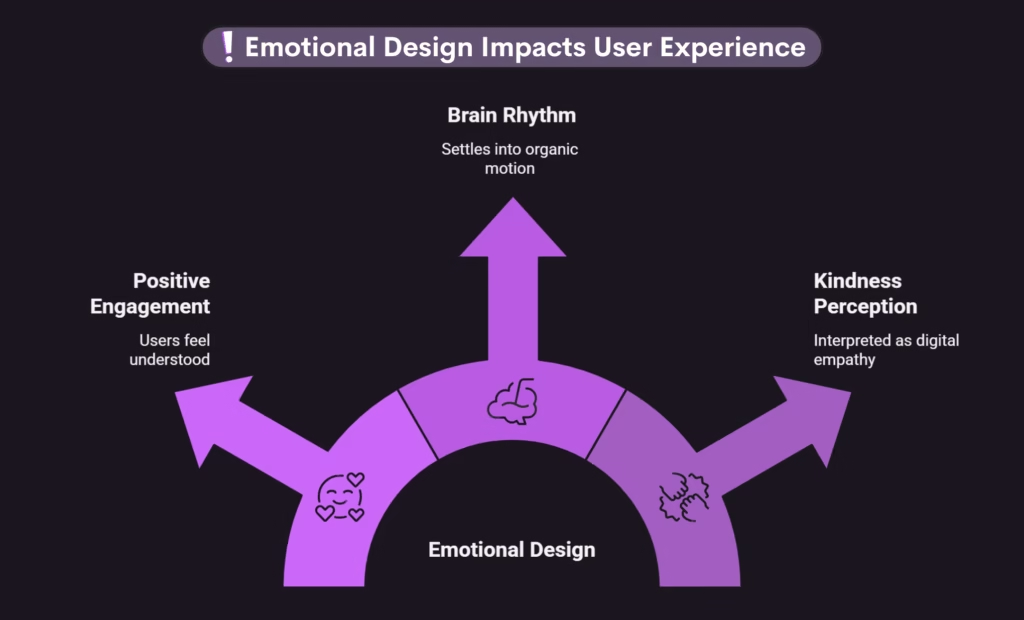
This happens because of how dopamine and pattern recognition work together: the brain rewards predictable, flowing patterns and punishes erratic ones. When an app’s movement feels organic — like breathing, floating, or pulsing — your brain settles into rhythm. It’s familiarity disguised as design.
That’s where digital empathy enters the chat.
When design elements seem emotionally aware — soft transitions, calming motion, conversational tone — users interpret it as kindness. It’s not real empathy, but the brain doesn’t always care.
It just feels understood.
Design Implications — When Motion Feels Human
Now that we know why humans get emotionally attached to lifelike design, how do we use that knowledge?
Here’s where anthropomorphic design becomes more than theory — it becomes a psychological toolkit.
1. Soft Motion, Soft Mind
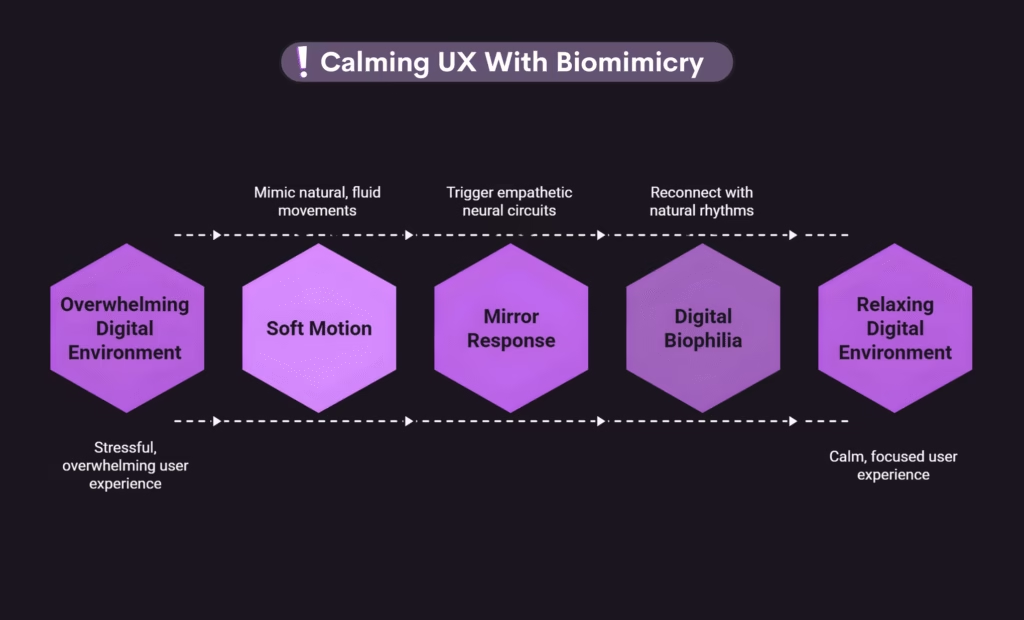
Fluid motion is to digital design what deep breathing is to the human body — it slows us down, quiets overstimulation, and signals safety.
When movement in an interface mimics jellyfish pulses, flowing gradients, or soft fades, it activates the parasympathetic nervous system — the body’s “calm mode.”
This system lowers heart rate, reduces anxiety, and helps users focus.
In short:
A calm design moves like water — not like code.
Designers can harness this by using “breathing” animations, wave-like transitions, and subtle, rhythmic motion. The effect? A digital environment that relaxes instead of overwhelms — where every transition feels like an exhale.
2. The Mirror Response Effect
Our brains are full of mirror neurons, the tiny empathetic circuits that fire when we see someone else move. They’re the reason you wince when someone stubs their toe, or smile when someone laughs.
And apparently, they don’t care if it’s human or robot.
When we see lifelike motion — a jellyfish pulse, a soft blink, a rhythmic sway — those neurons light up. We feel the movement.
In design, that means interfaces can subconsciously build trust and comfort just by mimicking life’s rhythm.
The more lifelike your motion, the more alive your design feels.
This is emotional design at its subtlest form — empathy through motion, not words.
3. Biomimicry as UX Therapy
Welcome to digital biophilia — the idea that humans crave nature, even inside screens.
When apps use organic motion, fluid textures, or ambient visuals, they reconnect us with the natural pace our brains evolved for.
It’s why background ripples, jellyfish-like animations, or sound-reactive glows feel so comforting.
Designs inspired by nature aren’t just aesthetic — they’re therapeutic. They mimic stability, predictability, and flow.
Gentle digital environments remind users that even inside the pixel world, peace is possible.
The Illusion of Life — Why Our Brains Want to Believe
We’re wired to believe in life, even when it isn’t there.
Evolution taught our brains: it’s safer to mistake a machine for a creature than a predator for a rock.
So when we see lifelike motion, those ancient circuits light up again.
The same neural loops that helped us detect life in the wild now activate when we see animated icons, robotic pets, or AI faces.
But there’s a limit — the uncanny valley. When tech becomes too realistic, our empathy falters and discomfort rises.
We love life-like things, but only if they still feel slightly… not alive.
It’s a strange paradox — we crave illusion, but recoil from perfection.
At what point, then, does imitation become emotion?
Anthropomorphic Design: The Ethics of Emotional Machines
Emotionally aware design is powerful — maybe too powerful.
The same principles that make an app feel calming or human can also be used to manipulate.
Dopamine-driven interfaces, endless-scroll feeds, AI companions that remember your name — they all play with our emotional wiring.
The line between connection and control blurs quickly.
Are we building empathy into technology, or teaching technology to use empathy against us?
Designers hold something delicate — the ability to create comfort, and the power to design for irresistible engagement.
Balance will define the future of emotional design.
Ever wonder why some human-like interactions keep you hooked and motivated? Your brain’s reward system might have something to do with it. Read the article here!
Anthropomorphic Design: The Pulse Beneath the Code
Down in the deep, the bionic jellyfish still drifts — its silent rhythm syncing with the sea. It isn’t alive, yet it moves in ways that awaken life in us.
And maybe that’s the truest kind of empathy there is: not born from consciousness, but from reflection.
Technology doesn’t need to feel emotion to make us feel it. It only needs to remind us of what emotion looks like.
Maybe what makes us human isn’t emotion itself — but our ability to see it everywhere, even in the machines we create.
In this new era of emotional UX and anthropomorphic design, we aren’t just shaping technology anymore.
We’re shaping the emotions that shape us.
Frequently Asked Questions
Anthropomorphism in design means giving human-like qualities — such as motion, emotion, or expression — to objects, interfaces, or technologies. In anthropomorphic design, creators use elements like gentle motion, “breathing” animations, or friendly tones to make digital experiences feel more alive and emotionally engaging. It helps bridge the gap between code and connection.
We use anthropomorphism because the human brain naturally seeks familiarity and emotion. When technology feels human, we respond with empathy, trust, and curiosity. Designers use this instinct to create emotional UX — interfaces that comfort users, reduce digital fatigue, and make interactions feel intuitive. In short: we feel closer to what feels alive.
The psychology behind anthropomorphism comes from our brain’s built-in survival wiring. We evolved to recognize life and emotion instantly — it helped us stay safe and connected. Today, those same neural pathways activate when we see lifelike motion in apps or AI. This makes anthropomorphic design powerful: it taps into empathy, mirror neurons, and emotional recognition to shape how we experience technology.
Biomimicry in design means taking inspiration from nature’s systems, patterns, and movements to solve human problems. In digital psychology, biomimicry and biophilia design create soothing experiences — think jellyfish-like fluid motion, soft gradients, or natural rhythms in interface animations. These designs don’t just look beautiful; they help users feel calmer and more connected.
Anthropomorphism in animation helps bring emotion and relatability to non-human characters. Whether it’s a talking robot or a glowing jellyfish, human-like movement and expression make viewers empathize with what they see. In modern anthropomorphic design, these same techniques are used in emotional UX — to make technology feel warmer, friendlier, and more alive.