
- How physicists think about the fifth dimension (no headache physics)
- Why hidden algorithms act like the internet’s version of dark matter: invisible, everywhere, and always shaping what we see.
- The surprising parallels between cosmic forces and digital psychology—from online gravity to emotional design.
- How dark UX patterns mimic dark matter by subtly pulling, nudging, and steering behaviour without being seen.
- Why our own minds have “hidden dimensions” too… and how screens warp them more than we think.
Physicists think our universe might hide a fifth dimension — a layer of reality we never directly see, yet one that might explain the strange, invisible forces shaping everything from particle behavior to the movement of galaxies. Recent discussions even explore how certain particles might behave as if they’re interacting with a hidden dimension, possibly giving clues about the invisible matter shaping the cosmos.
But isn’t that kind of how the digital world works?
Every time you open your phone, you walk into a space built on hidden algorithms, invisible psychology cues, and subtle design forces steering what you click, feel, and believe.
You don’t see these forces — you just experience their effects.
So maybe the fifth dimension isn’t far away in the cosmos.
Maybe we’re already living inside it… through our screens.
Let’s explore that.
The Hidden Dimension Explained
Physicists agree on four dimensions we experience:
- Length
- Width
- Height
- Time
But some modern theories suggest the universe might contain extra hidden dimensions — not places humans can walk into, but layers that influence the rules of reality.
The idea goes like this:
There are forces in the universe we can’t fully explain using only the dimensions we see.
For example:
⭐ Dark matter
A mysterious, invisible type of matter that:
- doesn’t reflect light
- doesn’t emit light
- doesn’t interact with light
- can’t be detected directly
…and yet it makes up most of the universe’s mass.
Galaxies shouldn’t even stay together based on what we can see. The planets and stars should be flinging away like glitter thrown into the wind.
But something invisible is holding them in place.
Some researchers explore whether this hidden stability could be connected to the behavior of particles in extra dimensions — not proven, not settled, just part of the conversation happening in modern physics.
Not magical portals.
Not sci-fi corridors.
Just extra layers of physics shaping reality without ever being visible.
If something invisible can move galaxies…
imagine how invisible systems move our minds.
Because the universe isn’t the only place with hidden structures. Your phone has them too.
Hidden Algorithms — The Fifth Dimension of Your Screen
Physics has invisible forces.
The digital world? Even more.
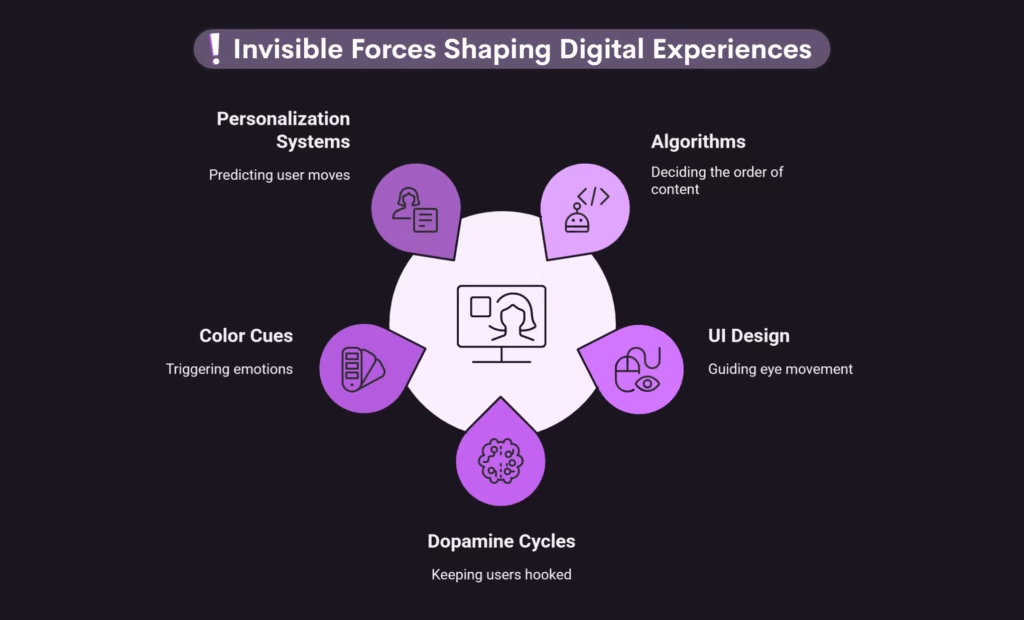
Every tap, swipe, scroll, save, click, and pause is shaped by:
- algorithms deciding the order of your content
- UI design guiding where your eyes travel
- dopamine cycles engineered to keep you hooked
- subtle color cues that trigger emotion
- personalization systems predicting your next move
You don’t see these structures — but they guide you constantly.
Hidden algorithms are the digital world’s version of dark matter.
Not visible.
Not touchable.
But always influencing the system.
Let’s break this into examples your brain will instantly recognize.
Online Gravity — How Hidden Algorithms Pull You In
Just like gravity keeps planets in orbit, digital systems keep you in orbit.
Infinite scroll = Time distortion
You think you scrolled 3 minutes.
Your screen: “It’s been 47 minutes.”
Infinite scroll removes natural stopping cues — your brain doesn’t get closure, so you keep going. Designers know this. Even UX researchers note how continuous scrolling quietly alters time perception.
Red notifications = Emotional steering, urgency, danger.
A red notification badge activates threat-response pathways. That’s why apps don’t use pastel green for alerts.
Suggested content = Behavioral gravity
You click one skincare video → suddenly you’ve fallen into a digital galaxy of serums and routines.
Your feed rearranges itself around your micro‑actions — clusters forming the same way cosmic structures cluster around invisible forces.
You don’t see the energy.
You just feel its pull.
Dark Matter ≈ Dark Patterns
Dark matter: Unseen, everywhere, holding galaxies together.
Dark patterns (in UX design): Unseen, everywhere, holding your attention together.
Different worlds… same trick.
Dark patterns are sneaky design choices that steer you without you realizing:
- “Are you SURE you want to unsubscribe?” with a sad emoji
- the bright “Accept All” button vs the microscopic “Manage cookies” link
- autoplay that never ends
- confusing “decline” or close buttons
- fake urgency timers
According to a 2023 Dovetail study, 56% of respondents reported losing trust in a website due to manipulative design.
And the most notorious:
🌀 Infinite scroll
No bottom.
No pause.
No moment where your brain says “stop.”
Many design audits over the last few years found that these subtle manipulations appear on a huge portion of subscription-based websites — so common that users reported losing trust because of them.
Dark matter keeps stars from flying apart.
Dark patterns keep you from flying off apps.
They operate behind the scenes, rewriting behavior silently.
The Human Fifth Dimension — The Mind
The universe isn’t the only thing with hidden dimensions.
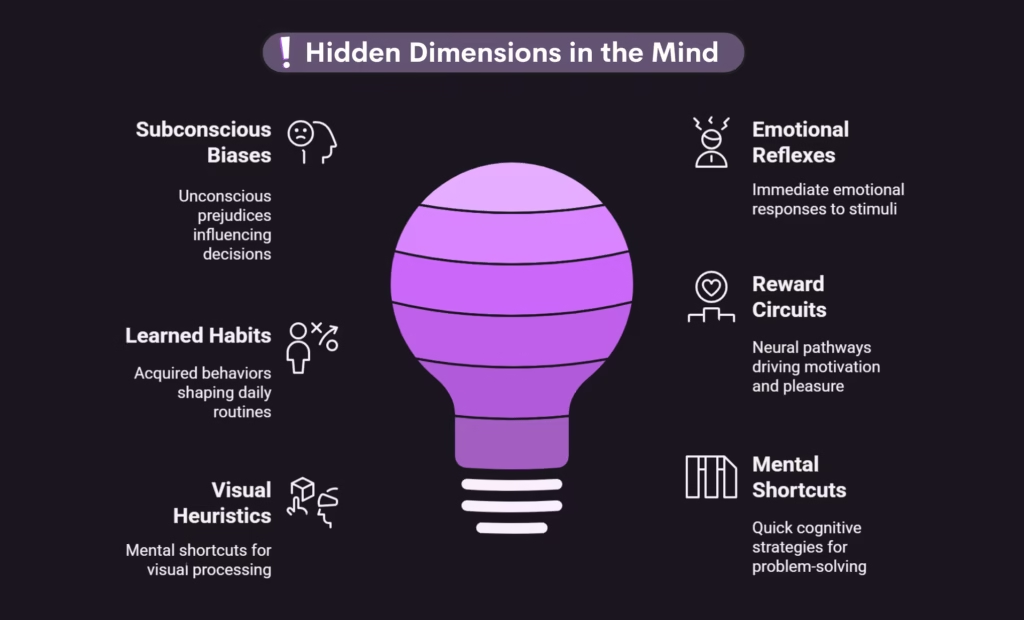
Your mind has them too:
- subconscious biases
- emotional reflexes
- learned habits
- reward circuits
- visual heuristics
- mental shortcuts
And digital design knows how to tug on each of them.
Examples:
- Contrast psychology: High contrast buttons feel more “right.”
- Color psychology: Blues = trust. Reds = urgency.
- Layout hierarchy: Your eyes travel in predictable patterns.
- Micro-animations: Tiny movements hold attention.
- Fake scarcity: “Only 2 left” even when it’s not.
Your mind bends digital space…
and digital space bends your mind.
Just like physicists use hidden dimensions to explain strange cosmic behaviors —
psychologists use mental “hidden layers” to explain digital behaviors.
A Digital Universe — Where Both Theories Intersect
What if the internet is our version of a fifth dimension?
Not a sci-fi tunnel. Not a secret galaxy.
But a hidden layer connecting billions of minds, shaping behavior, and reorganizing reality — all without being physically visible.
You don’t see:
- the ranking systems
- the hundreds of signals shaping your feed
- the personalization layers
- the behavioral predictions
- the engagement models
But they’re there.
Shaping what appears. Shaping what you believe. Shaping what you “randomly discovered.”
Cosmic forces warp space.
Design psychology warps perception.
Both influence worlds we live in.
Both are invisible.
Both make reality feel the way it feels.
If you were surprised by the online gravity and how we orbit this digital universe, read this to learn more about manipulative design.
Hidden Algorithms: Final Thoughts
The fifth dimension might never be a place we physically visit.
But every day, we navigate layers of reality we don’t see — physics, psychology, and the quiet world of hidden algorithms.
And maybe the magic isn’t in traveling somewhere new…
It’s in realizing how much is already here, shaping us quietly.
Some forces guide stars. Others guide thoughts.
Both remain invisible — until you learn how to see them.
Frequently Asked Questions
The fifth dimension is a hidden layer of reality that physicists propose exists beyond the three dimensions we move in and time. It’s unseen but could explain invisible forces like dark matter shaping the universe.
A dark UX pattern is a hidden design choice on websites or apps that subtly manipulates users into actions they might not intend, like clicking a button or staying on a page longer.
Dark patterns exploit subconscious behaviors, emotional triggers, and mental shortcuts. They work like hidden algorithms, quietly guiding choices and influencing attention without users realizing it.
Manipulative design is any interface or feature that nudges you to act a certain way — often using color, layout, or timing — without making it obvious.
Hidden dimensions are layers we can’t directly see, either in the universe (like the fifth dimension) or in our minds. In digital life, hidden algorithms create a “fifth dimension” that shapes what we see and do online.