
- Why curiosity existed long before the internet
- How digital environments expanded who we learn from
- Why access to people may matter more than access to information
- The psychology behind digital curiosity and question asking
- Why some questions become better when they remain unanswered for a while
Prefer visual explanations? A summary graphic appears at the end of the article.
This week, I found myself writing three very different emails.
One went to another student pursuing a dream abroad.
Another went to a dermatologist about a small question in clinical reasoning.
The third went to a baker.
Not because I needed a recipe.
Because I wanted to understand why certain cakes seem to taste even better the following day.
Three conversations. Three completely different subjects.
Yet somewhere between pressing “Send” and waiting for replies, a quieter thought began to form.
Individually, none of those emails felt particularly remarkable.
Together, however, they pointed toward something I had never quite put into words.
We often describe the internet as a place full of information.
But perhaps information isn’t its most interesting contribution.
The internet quietly changed something much older than search engines or social media.
Curiosity itself.
Not by creating it.
But by changing where it can travel.
Curiosity Was Never Invented
Long before smartphones, people were already asking questions.
Children asked why the sky changed color at sunset.
Parents passed recipes from one generation to the next.
Neighbors exchanged gardening advice over fences.
Teachers filled blackboards with ideas that stretched far beyond the classroom.
Libraries waited for anyone willing to wander their shelves.
Curiosity has always been part of being human.
Psychologists often describe one form of it as epistemic curiosity: the desire to understand something simply because not knowing feels incomplete.
It isn’t driven by rewards or deadlines.
It’s driven by a quiet feeling that there is something worth discovering.
That feeling existed centuries before the internet.
People wondered. Observed. Experimented. Asked.
Sometimes they found answers.
Sometimes they discovered even better questions instead.
Digital curiosity, then, isn’t a completely new kind of curiosity.
It’s the same human instinct moving through a very different landscape.
Digital Curiosity: When Distance Stopped Choosing Our Teachers
For most of history, curiosity travelled only as far as circumstances allowed.
If you wanted to understand bread, you asked the local baker.
If you wanted to learn about plants, perhaps there was a gardener nearby.
If you were fortunate enough to know a scientist, doctor, artist or teacher, their knowledge became part of your world.
If not, many questions simply remained unanswered.
Geography usually determined who shaped your thinking.
Today, that boundary feels remarkably different.
A student can exchange ideas with another student living on the other side of the world.
A hobby photographer can learn from professionals they may never meet.
Someone fascinated by astronomy can read explanations written by researchers whose observatories are thousands of kilometers away.
The internet didn’t remove curiosity’s need for people.
It expanded the number of people curiosity could reach.
Learning became less dependent on proximity and more dependent on connection.
Perhaps one of the quietest changes brought by digital environments wasn’t giving us more information.
It was giving our questions a much larger world to explore.
Geography No Longer Decides Who Shapes Our Thinking
This shift changes something surprisingly profound.
The people who influence our thinking are no longer chosen primarily by where we happen to live.
Increasingly, they’re chosen by what we’re curious about.
Someone interested in medicine might regularly learn from physicians they’ve never met.
An illustrator might discover techniques from artists living on another continent.
A teenager fascinated by philosophy can spend an evening reading essays written decades earlier by people who never imagined their work would travel so far.
Our intellectual neighborhood has quietly expanded.
Digital curiosity allows ideas to cross borders long before we ever do.
The radius of learning has become remarkably flexible.
And with it, so has the range of perspectives that can shape the way we see the world.
Access to Information Is Helpful. Access to Minds Is Different.
We often say the internet gives us access to information.
That’s true.
But information and people aren’t quite the same thing.
Information answers questions.
People often improve them.
A search engine might explain what happened.
A researcher can explain why it matters.
A baker can describe the tiny observations that never appear in a recipe.
A fellow student can offer encouragement that no textbook could provide.
Psychologists have long recognized that much of human learning is social.
We don’t simply collect facts.
We learn by observing, discussing, questioning, refining, and sometimes having our assumptions challenged.
That may be one of the internet’s quietest gifts.
Not that it placed the world’s information within reach.
But that it placed more of the world’s people within reach of our curiosity.
Digital Curiosity: Questions We Borrow
Not every question begins with us.
Sometimes curiosity starts somewhere else.
A scientist wondering how black holes behave.
A designer explaining why certain colors feel calming.
A teacher asking students to consider an idea they had never encountered before.
One thoughtful question often gives rise to another.
Psychologists have long recognized that curiosity can spread socially. Watching someone become genuinely fascinated by an idea often encourages us to explore it ourselves.
Curiosity doesn’t always spread because people share answers. It also spreads because they share questions.
In that sense, the internet doesn’t simply distribute information.
It distributes curiosity itself.
Every thoughtful conversation has the potential to become the beginning of someone else’s.
And maybe, some of the questions we consider “our own” first belonged, quietly and generously, to someone else.
The Hidden Cost of Instant Answers
If the internet expanded where curiosity can travel, it also changed something else.
The speed at which uncertainty disappears.
For most of history, questions often remained unanswered for days, weeks, or even years.
People observed. Discussed. Compared ideas. Visited libraries. Asked neighbors. Wondered a little longer.
Today, many questions disappear within seconds.
A search bar appears. An answer arrives.
The uncertainty quietly dissolves.
In many situations, that’s a remarkable improvement.
Accurate information saves time. It prevents mistakes. Sometimes it even saves lives.
Yet curiosity isn’t only about reaching answers.
It’s also about the journey between asking and understanding.
That quieter part of learning can easily become shorter than it once was.
Digital Curiosity: A Small Comparison
Sometimes our learning follows this path:
Immediate search → Immediate certainty
Sometimes it follows another:
Observation → Reflection → A better question → A better answer
Neither path is wrong.
But they don’t always lead to the same kind of understanding.
Some answers satisfy curiosity. Others deepen it.
Better Questions
Maybe one of the internet’s greatest opportunities isn’t simply helping us answer questions. It’s also helping us ask better ones.
There is a quiet difference between asking,
“How do I bake a cake?”
and asking,
“Why does this cake taste richer the next day?”
Both questions lead somewhere. The second often leads further.
It invites explanation instead of instruction.
Understanding instead of imitation.
The internet gives us extraordinary access to expertise.
But expertise becomes most valuable when paired with thoughtful questions.
Sometimes the quality of what we learn depends less on how quickly we search, and more on what we decide to ask.
Curiosity isn’t only measured by the number of answers we collect.
Sometimes it’s measured by how interesting our questions become.
Curiosity Creates Unexpected Connections
Looking back, the three emails that inspired this article had very little in common.
A student.
A dermatologist.
A baker.
Education. Medicine. Food.
At first glance, they seemed to belong to entirely different worlds.
Yet each conversation reflected the same underlying instinct.
Curiosity crossing boundaries.
One question leading toward another person.
One perspective leading toward another idea.
One discipline unexpectedly illuminating another.
This is perhaps one of the most fascinating aspects of digital curiosity.
Questions are no longer confined to the communities where they first appear.
They move.
Across professions, countries, and generations.
Across subjects that would rarely meet in the same room.
Sometimes learning isn’t about travelling further ourselves.
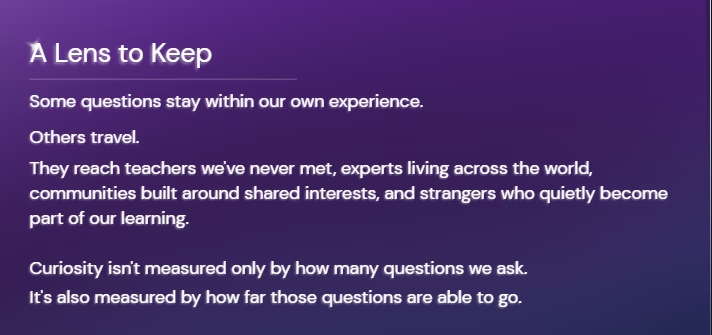
Sometimes it’s our questions that do the travelling.
Curiosity Radius
One way to think about this shift is through a simple conceptual lens.
Curiosity Radius
Definition: Curiosity Radius describes the practical distance a question can travel: the range of people, perspectives, and disciplines an individual can realistically reach while exploring an idea.
Centuries ago, that radius was often limited by geography.
Today, it is increasingly shaped by connection.
The internet hasn’t changed our desire to understand the world.
It has expanded the number of minds that can help us understand it.
Perhaps the greatest change wasn’t just technological.
It was geographical.
Digital Curiosity: A Quiet Reflection
The internet’s greatest contribution wasn’t just placing the world’s information into our pockets.
Perhaps it quietly placed more of the world’s people within reach of our questions.
Curiosity wasn’t limited by imagination.
Only by distance.
Today, a thoughtful question can travel further than it ever could before.
At the same time, perhaps curiosity deserves something else as well.
Not every question needs an immediate answer.
Some become richer when they are carried for a while.
When they’re discussed over dinner. Written in the corner of a notebook. Returned to during a quiet walk.
Or slowly refined before they’re finally asked.
The internet has expanded the radius of our curiosity.
The quieter challenge is deciding how we use that remarkable gift.
Because perhaps curiosity was never simply about collecting answers.
Perhaps it has always been about becoming the kind of person who continues asking thoughtful questions.
And in a world where almost anyone can answer us…
Choosing to ask a better question may become one of the most valuable skills we can cultivate.
Visit: A gentle visual guide to the research concepts that inspired this article.
Frequently Asked Questions
Digital curiosity describes how online environments expand the ways people explore questions, discover ideas, and learn from others. Rather than creating curiosity, the internet broadens who we can learn from and where our questions can travel.
The internet has made learning less dependent on geography. Today, people can learn from researchers, creators, professionals, educators, and communities across the world through articles, videos, online discussions, and direct conversations.
Psychology suggests that allowing uncertainty to linger can encourage deeper observation, reflection, and more thoughtful questions. Instead of ending curiosity quickly, a short period of wondering can sometimes strengthen it.
Curiosity is often described as a motivation to close the gap between what we know and what we want to know. Researchers have linked it to exploration, learning, memory, creativity, and long-term knowledge building.
Yes. Seeing other people ask thoughtful questions, share discoveries, or explain ideas can inspire curiosity in others. In this way, curiosity often spreads socially through conversations and communities.
Not necessarily. Instant answers can make learning faster and more accessible. However, some psychologists suggest that spending time observing, reflecting, and refining a question before searching can lead to deeper understanding and more meaningful learning.