
- What the Bubble Face trend actually refers to
- What social media exaggerated
- Why risky beauty trends spread online
- The psychology of delayed consequences
- How algorithms amplify beauty standards
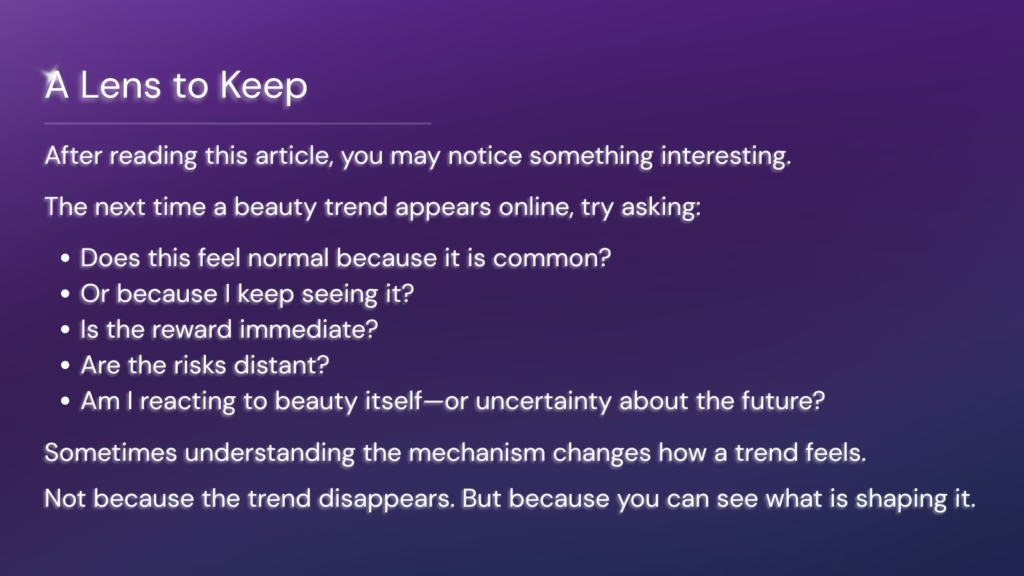
Prefer visual explanations? A summary graphic appears at the end of the article.
Bubble Face.
The phrase sounds almost fictional.
Depending on the internet and observations, it can refer to swollen facial features, cosmetic procedures gone wrong, beauty standards, or even an entire generation supposedly damaging their appearance in pursuit of youth.
Social media transformed the term into a mixture of warning, curiosity, and fear.
One video presents it as a medical complication.
Another presents it as a beauty epidemic.
A third treats it like a cautionary tale about modern appearance culture.
But beneath the dramatic headlines lies a more interesting question:
Why do beauty trends continue spreading even when people know there may be risks?
To understand the psychology behind Bubble Face, we first need to separate medical reality from internet storytelling.
What Is the Bubble Face China Trend?
The phrase Bubble Face became popular online through discussions about cosmetic procedures and facial appearance changes.
Although definitions vary across videos and posts, the term is most commonly associated with concerns about excessive facial volume, swelling, cosmetic fillers, or procedure-related complications.
In discussions surrounding Bubble Face China, the phrase is often linked to stories of facial injections, aesthetic treatments, and images showing unusually swollen facial features.
The important detail, however, is that the phrase itself is largely a social media label.
It is not a formal medical diagnosis.
Instead, it functions as an internet shorthand—an easy way to describe a collection of fears, observations, and assumptions surrounding cosmetic enhancement.
Some of the medical concerns discussed online are real.
Complications from cosmetic procedures can occur, particularly when treatments are performed improperly, excessively, or without appropriate oversight.
But social media rarely stops at reality.
It tends to build stories around it.
And stories spread faster than nuance.
Medical Reality vs Social Media Reality
This is where things become interesting.
Medical reality and social media reality often operate at different scales.
A medical case may involve a specific complication affecting a specific person.
Social media may transform that same case into a symbol of a much larger cultural fear.
One unusual outcome becomes:
“This is happening everywhere.”
One complication becomes:
“Nobody talks about the risks.”
One dramatic image becomes:
“An entire generation is ruining their faces.”
The result is a mixture of truth and amplification.
Real complications exist. Real procedures exist.
But the internet often magnifies unusual outcomes because unusual outcomes attract attention.
And attention is what social platforms are designed to distribute.
Understanding that distinction matters.
Because the psychology behind Bubble Face China is not just about cosmetic procedures.
It is also about how human beings interpret risk, beauty, and uncertainty in highly amplified digital environments.
The Psychology of Delayed Consequences
Most people do not make decisions by carefully calculating every possible future outcome.
We like to imagine that we do.
But psychologically, the present usually feels louder than the future.
Researchers often describe this tendency through a concept called temporal discounting.
Temporal discounting refers to our tendency to value immediate rewards more strongly than future consequences.
At first glance, this might seem irrational.
But it is actually a very normal part of human decision-making.
The brain naturally pays greater attention to outcomes that feel immediate, visible, and emotionally relevant.
That helps explain why many beauty decisions can feel compelling even when risks are understood.
A person is rarely comparing:
“I look great today.”
with
“I may experience a complication three years from now.”
Instead, the brain often compares:
“I look great today.”
with
“Nothing changes today.”
And that is a very different decision.
One option offers an immediate emotional reward.
The other offers uncertainty.
This doesn’t only apply to cosmetic procedures.
The same psychological mechanism appears when people procrastinate, overspend, skip exercise, or postpone difficult conversations.
The future matters. But the present feels real.
Future You may be deeply concerned about long-term consequences.
Present You, unfortunately, is the one holding the credit card.
And when beauty standards, social comparison, and emotional rewards enter the picture, the present can become even more persuasive.
Bubble Face China: When Beauty Becomes a Moving Target
If delayed consequences help explain why beauty trends spread online, another psychological concept helps explain why they often escalate.
It is called hedonic adaptation.
The idea is surprisingly simple:
Humans adapt to improvements.
Quickly.
A new phone feels exciting. Then normal.
A new house feels exciting. Then normal.
A new hairstyle feels exciting. Then normal.
Beauty changes often follow the same pattern.
The brain is excellent at noticing improvement.
It is considerably less talented at staying impressed by it.
What once felt exciting gradually becomes familiar.
The result is a subtle psychological shift:
A change that once felt significant begins to feel ordinary.
And when “ordinary” arrives, the mind naturally starts looking for the next improvement.
This doesn’t mean people are irrational.
It means they are human.
A common progression might look something like this:
- skincare routines
- teeth whitening
- lip enhancements
- facial contouring
- preventative treatments
Not everyone follows this path, of course.
But the pattern itself reflects something important:
The goalposts move.
What once felt like a major improvement becomes the new normal.
And the new normal rarely stays new for long.
The Beauty Escalation Effect
This leads to a broader pattern we might call the Beauty Escalation Effect.
The Beauty Escalation Effect describes how repeated exposure to increasingly enhanced beauty standards gradually shifts perceptions of what looks normal.
At first, an aesthetic may seem extreme.
Then it becomes familiar.
Eventually, it becomes expected.
Social media accelerates this process.
When highly edited images, filters, cosmetic enhancements, and carefully curated appearances appear daily, the brain begins adjusting its internal definition of “normal.”
The shift happens quietly.
What once looked exceptional starts looking average.
What once looked average starts looking inadequate.
The standards move.
And most people don’t even notice they moved.
Social Proof and the Algorithm Beauty Loop
One of the most powerful explanations for why beauty trends spread online has nothing to do with beauty itself.
It has to do with other people.
Psychologists call this social proof.
When people are uncertain about a decision, they often look to others for clues about what is acceptable, desirable, or normal.
This strategy is usually helpful.
If everyone in a crowd runs away from something, you probably don’t stop to conduct independent research.
You run too.
The brain assumes that large groups contain useful information.
This works wonderfully when avoiding danger.
It works slightly less wonderfully when everyone suddenly decides the same beauty trend is essential.
If your feed constantly shows:
- flawless skin
- sculpted facial features
- cosmetic procedures
- anti-aging routines
- “before and after” transformations
the brain begins noticing a pattern.
And eventually it reaches a conclusion.
Not:
“This must be safe.”
But:
“This must be normal.”
That distinction matters.
Normality and safety are not the same thing.
Yet our brains often treat them as if they are close relatives.
Algorithmic Reinforcement
This effect becomes even stronger because of how social media platforms operate.
The algorithm does not ask:
“Is this healthy?”
It asks:
“Is this engaging?”
Content that generates reactions travels further.
Content that sparks curiosity travels further.
Content that creates comparison often travels further too.
As a result, highly visual beauty content can become disproportionately visible.
The average user is usually not seeing all beauty-related content.
They are seeing the content that performed best.
And the content that performs best is often the most dramatic, polished, aspirational, or emotionally charged.
Over time, this can create a distorted perception of reality.
Not really because anyone is lying.
But because algorithms amplify attention, not accuracy.
This helps explain why beauty standards psychology has become such an important topic in digital environments.
The standards people compare themselves to are no longer limited to friends, classmates, or coworkers.
They are increasingly shaped by algorithmically selected highlights from thousands of strangers.
Bubble Face China: Preventive Aging Anxiety
For many years, cosmetic treatments were largely associated with visible signs of aging.
Today, something interesting is happening.
Many people are becoming concerned about aging before aging has actually arrived.
This phenomenon could be described as preventive aging anxiety.
Instead of responding to wrinkles, people respond to the possibility of wrinkles.
Instead of addressing visible changes, they focus on future changes that may or may not occur.
The motivation shifts.
The concern is no longer:
“I look older.”
Sometimes it becomes:
“I might potentially look older at some unspecified point in the future and I would like to begin worrying immediately.”
At first glance, this seems unusual.
But psychologically, it makes sense.
Human beings dislike uncertainty. And aging is one of the most universal forms of uncertainty we experience.
Nobody knows exactly how they will age.
Nobody knows what they will look like in ten or twenty years.
That uncertainty can create discomfort.
Beauty products, treatments, and procedures often offer something emotionally appealing:
A sense of control.
Whether that control is realistic, exaggerated, or temporary depends on the situation.
But psychologically, the promise itself is powerful.
Sometimes people are not chasing youth.
They are chasing certainty.
And certainty is often easier to market than reality.
Why Bubble Face Became a Viral Story
The popularity of Bubble Face China is not only a beauty story.
It is also an internet story.
The phrase contains several ingredients that social media tends to amplify naturally.
✧ Fear
People share warnings.
Especially when those warnings involve health, appearance, or personal safety.
A story framed as:
“Be careful.”
travels quickly.
Fear captures attention because the brain treats potential threats as important information.
✧ Shock
Visual transformations are highly shareable.
A dramatic image requires very little explanation.
Someone scrolling can understand the emotional impact within seconds.
And online, speed matters.
The easier something is to understand, the easier it is to spread.
✧ Moral Drama
The internet loves stories with clear heroes, villains, mistakes, and lessons.
A headline like:
“Look what happened.”
often receives more attention than:
“Most procedures went normally.”
Because drama travels.
Nuance walks.
One creates immediate emotional reaction. The other requires patience.
And nuance rarely wins a race against a dramatic thumbnail.
This does not mean the concerns are fake.
It means that dramatic examples are often more visible than ordinary ones.
And visibility shapes perception.
The more frequently people see a story, the more common it appears.
Even when the underlying event remains relatively rare.
That is one reason why discussions around Bubble Face China became so much larger than the original cases themselves.
The psychology of virality amplified the psychology of beauty.
A Bigger Question About Beauty
And perhaps that is what makes stories like Bubble Face so compelling.
Not because most people are planning cosmetic procedures.
Not because everyone is worried about beauty.
But because almost everyone has felt that tension somewhere else.
The gap between what feels good now and what might matter later.
Bubble Face simply makes that tension visible.
In another context, it might look like procrastination.
Or impulse spending.
Or buying something because Future You will “definitely use it.”
(We all know Future You has been carrying an unreasonable amount of responsibility lately.)
The details change.
The psychology often stays surprisingly similar.
We are drawn not only to beauty, but to the feeling of control it offers in an uncertain world.
And that may be the real lesson hidden beneath the trend.
Human beings rarely make decisions using facts alone.
We make them using emotion.
Possibility. Social influence. Uncertainty.
And sometimes, despite everything we know, the present moment still wins.
Because the future is important.
But the present is standing right in front of us.
Frequently Asked Questions
The term “Bubble Face” is a social media label often used to describe concerns about facial swelling, excessive cosmetic enhancement, or procedure-related complications. While it is frequently linked to cosmetic treatments and beauty trends, it is not a formal medical diagnosis. The phrase has become a broader internet shorthand for discussions about appearance, aging, and cosmetic intervention.
Psychologists often point to a concept called temporal discounting. People naturally give more weight to immediate rewards than distant consequences. A visible improvement today often feels more emotionally significant than a possible risk years later, making certain beauty trends more appealing despite known concerns.
Beauty standards are influenced by several psychological factors, including social proof, comparison, familiarity, and cultural norms. When people repeatedly see the same appearance ideals online, those ideals can begin to feel normal, desirable, or even expected, regardless of how common they are in everyday life.
Social media algorithms tend to amplify content that generates attention and engagement. Highly visual beauty content often performs well, which can make certain appearances, procedures, or aesthetics seem more common than they actually are. Over time, this can shape perceptions of what is considered attractive or normal.
Preventive aging anxiety refers to concern about future signs of aging before those signs are actually present. Instead of responding to visible changes, individuals may focus on avoiding potential future changes. This can make anti-aging products, treatments, and beauty interventions feel psychologically appealing because they offer a sense of control over uncertainty.
Beauty standards change because people quickly adapt to what they see regularly. This process, known as hedonic adaptation, means that appearances once viewed as exceptional can gradually become familiar. As expectations shift, new trends emerge and the cycle continues.
Not necessarily. Online visibility and real-world prevalence are not the same thing. Social media platforms often amplify content that attracts attention, which can create the impression that a trend is widespread even when exposure is being driven by algorithms rather than actual frequency.