
- Why does finding an answer sometimes feel like understanding it?
- What does digital humility actually mean?
- Why do experts often leave room for uncertainty?
- How can better questions lead to deeper learning?
- What might digital spaces look like if they encouraged reflection instead of certainty?
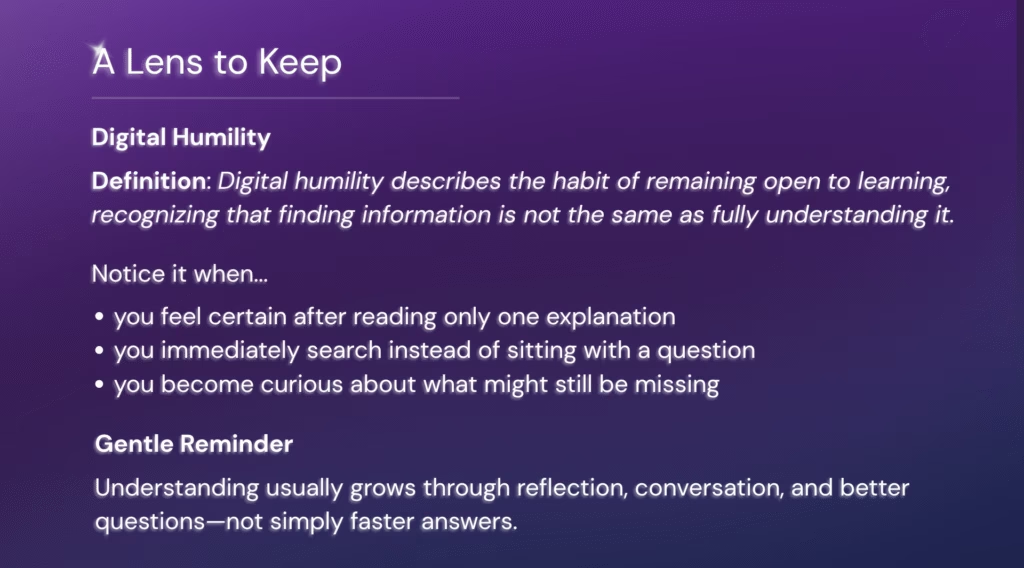
Prefer visual explanations? A summary graphic appears at the end of the article.
A question appears in your mind.
Within seconds, an answer appears on your screen.
A search result.
A short video.
An AI summary.
A confident thread.
A beautifully designed infographic.
A blog post explaining everything in five minutes.
You close the tab feeling as though you’ve learned something.
In many cases, you have.
Access to knowledge has never been easier.
Yet there is another possibility that receives far less attention.
Sometimes we encounter an answer before our understanding has had time to develop.
Information arrives almost instantly.
Understanding rarely does.
The internet has transformed one of the oldest human experiences: learning.
Questions that once required hours in a library or conversations with teachers, experts, or friends—can now be explored in moments.
That accessibility has opened extraordinary opportunities for curiosity.
At the same time, it invites a quieter challenge.
How do we remain thoughtful learners when answers often arrive faster than reflection?
Knowing Feels Easier Than Ever
Learning today often begins with remarkable tools.
A search engine introduces an unfamiliar concept.
An infographic simplifies a complicated idea.
A podcast turns research into conversation.
A short video makes a difficult topic feel approachable.
Artificial intelligence can summarize articles, explain terminology, and organize information within seconds.
None of these technologies are the problem.
In many ways, they represent one of the greatest expansions of human learning in history.
The challenge lies somewhere else.
Finding information isn’t the same as constructing understanding.
Psychologists have long studied something known as the illusion of explanatory depth.
People often believe they understand everyday objects or ideas much better than they actually do, until they’re asked to explain them in detail.
The gap usually comes as a surprise.
Knowing about something can feel remarkably similar to truly understanding it.
Digital environments can make that feeling even stronger.
When information is easy to access, our minds sometimes mistake accessibility for mastery.
The answer was only a few seconds away.
Understanding may still be several conversations, reflections, and questions away.
The Feeling of Understanding
Imagine watching several videos about skincare over the course of a week.
You begin recognizing familiar ingredient names.
Retinol. Niacinamide. Ceramides.
Soon, the topic starts to feel comfortably familiar.
That feeling matters more than we sometimes realise.
Psychologists have found that familiarity often influences our judgments.
The more often we encounter an idea, the easier it feels to process.
And ideas that feel easy to process can also begin to feel more convincing or better understood than they really are.
This doesn’t mean we’ve learned nothing. Repeated exposure genuinely helps us build knowledge.
But familiarity can occasionally whisper a subtle message:
“I understand this now.”
Even when our understanding is still developing.
There’s a meaningful difference between recognising an idea and being able to explain it, question it, compare it with alternatives, or apply it thoughtfully in new situations.
One is the beginning of learning.
The other is where deeper understanding gradually takes shape.
Digital life gives us remarkable opportunities to encounter information.
Learning still asks us to spend time with it.
What Digital Humility Actually Means
After spending time online, it can become surprisingly easy to confuse uncertainty with weakness.
Someone says,
“I’m not entirely sure.”
Another says,
“This is definitely true.”
The second voice often feels more convincing.
Not necessarily because it understands more.
But because certainty is naturally persuasive.
Digital humility offers a different way of thinking.
It doesn’t mean doubting everything you read. It doesn’t mean assuming every opinion is equally valid.
And it certainly doesn’t mean lacking confidence.
Instead, digital humility is the willingness to recognize that understanding is often still growing.
Rather than saying,
“I’m probably wrong,”
it quietly asks,
“What might I be missing?”
That single question changes the entire learning experience.
Instead of just defending what we already know, we become more willing to refine it.
Psychologists studying intellectual humility have found that people can remain confident while also acknowledging the limits of their current understanding. Those two qualities aren’t opposites. In many cases, they strengthen one another.
The goal isn’t to think less of what we’ve learned.
It’s to leave enough room for what we haven’t learned yet.
Perhaps one of the healthiest digital habits we can develop isn’t collecting more answers.
It’s becoming comfortable with the idea that every answer is part of a much longer conversation.
Digital Humility: Curiosity Before Certainty
The internet gives us answers remarkably quickly.
Digital humility helps us decide what to do after we find one.
Imagine searching,
“Which skincare ingredient is best?”
Within seconds, you’ll probably find dozens of recommendations.
But another question might open a much richer path.
“Why do dermatologists sometimes disagree?”
The first question looks for a conclusion. The second explores the reasoning behind it.
Or consider another everyday example.
You might ask,
“Is coffee healthy?”
A more curious question could become,
“Why do nutrition studies sometimes reach different conclusions?”
Neither question is wrong.
In fact, most deeper questions begin with simpler ones.
Learning often unfolds that way.
A straightforward question satisfies our immediate curiosity.
That answer then reveals a new question we hadn’t considered before.
Psychologists sometimes describe curiosity as something that expands rather than ends. Each answer can expose another gap in understanding, inviting us to explore a little further.
Digital humility encourages us not to stop at the first feeling of certainty.
It gently asks,
“What question comes next?”
Knowledge can be downloaded. Understanding still has to be grown.
Understanding isn’t always measured by how quickly we arrive at an answer.
It’s measured by how willing we are to keep exploring after we’ve found one.
Digital Humility: Experts Are Still Learning
One of the most interesting things about expertise is that it often sounds less certain than we expect.
Listen carefully to researchers, physicians, or scientists discussing subjects they know well.
You’ll often hear phrases like:
“It depends.”
“The current evidence suggests…”
“We’re still investigating.”
“There are several possible explanations.”
At first, those answers can feel less satisfying than a simple yes or no.
But they’re often signs of something important.
Experts usually spend enough time with a subject to see its complexity.
They’ve encountered exceptions.
Conflicting evidence.
New discoveries.
Questions that remain unresolved.
Psychologists sometimes describe a related pattern through the Dunning–Kruger effect: people with limited knowledge may overestimate how much they understand, while those with deeper knowledge become increasingly aware of what they still don’t know.
That doesn’t mean experts are always uncertain, or that beginners are always overconfident.
Human behavior is far more nuanced than that.
But it reminds us of something worth remembering.
The closer we move toward genuine understanding, the easier it becomes to appreciate how much remains unexplored.
Digital humility doesn’t ask us to know less.
It encourages us to become more comfortable learning alongside uncertainty.
Because understanding isn’t a destination we arrive at once.
It’s something we continue refining.
Designing Spaces That Leave Room to Think
Digital humility isn’t only a personal habit.
It’s also something digital environments can quietly encourage.
Every website, platform, classroom, or learning space teaches us something about how knowledge works.
Sometimes that lesson is,
“Find the answer as quickly as possible.”
Sometimes it’s,
“Keep scrolling.”
But imagine if digital spaces occasionally invited something different.
✦ Show confidence honestly.
Not every question has the same level of evidence.
Some ideas are supported by decades of research. Others are still developing.
Communicating that difference isn’t a weakness.
It’s part of honest learning.
✦ Reward better questions.
Imagine finishing an article and seeing,
Questions worth exploring next
instead of simply,
Related articles.
One encourages us to consume more. The other encourages us to think a little deeper.
✦ Design pauses.
Digital environments rarely stop moving.
Another notification. Another recommendation. Another video.
What if they occasionally asked,
“Has this changed how you think?”
or
“What surprised you most?”
Even a brief pause creates space for reflection.
✦ Normalize unfinished understanding.
Some of the most valuable ideas are still evolving.
Rather than presenting every topic as complete, thoughtful digital environments could acknowledge that knowledge often grows over time.
Science continues.
Questions continue.
Learning does too.
Just as white space makes a page easier to read, intellectual breathing room makes ideas easier to question.
Intellectual Breathing Room
Definition: Intellectual Breathing Room describes the intentional space left for uncertainty, reflection, and continued learning instead of rushing toward immediate certainty.
Understanding doesn’t always become stronger by becoming faster.
Sometimes it becomes stronger by having room to grow.
Curiosity often begins with finding an answer. Understanding often begins with asking a better question.
If you enjoyed this idea, you might also like Digital Curiosity: How The Internet Changed The Way We Learn, where we explore how the internet reshaped not curiosity itself, but where it can travel. ☕
A Quiet Reflection
Perhaps one of the quietest ways digital culture shapes us isn’t through what it teaches.
It’s through what it teaches us to expect.
When answers appear instantly, we begin expecting understanding to arrive just as quickly.
When confidence is rewarded, certainty can begin to feel more valuable than curiosity.
When every question seems to have an immediate response, it’s easy to forget that some of the most meaningful questions have never had simple answers.
Digital humility offers a different rhythm.
It reminds us that changing our minds isn’t a failure.
That saying “I don’t know yet” can be the beginning of deeper learning rather than the end of it.
That understanding is often something we build gradually, one thoughtful question at a time.
Perhaps the most valuable digital environments of the future won’t simply help us find answers faster.
Perhaps they’ll help us remain curious for longer.
Because information can arrive in seconds.
Understanding rarely does.
And maybe that’s exactly what makes it worth pursuing.
Frequently Asked Questions
Digital humility is the willingness to recognize that encountering information isn’t the same as fully understanding it. Rather than doubting everything, it encourages openness to continued learning, reflection, and better questions.
When information is easy to access and repeatedly encountered, our brains can mistake familiarity for genuine understanding. Psychology describes related ideas such as the illusion of explanatory depth, where people often realize they understand less than they initially believed once they’re asked to explain something in detail.
Experts frequently recognize the complexity of their field, including exceptions, evolving evidence, and unanswered questions. As understanding grows, people often become more aware of what remains uncertain rather than less.
A helpful approach is to treat your first answer as the beginning rather than the end of learning. Ask follow-up questions, compare different perspectives, and leave room for your understanding to evolve over time.
Intellectual Breathing Room is a conceptual lens describing the intentional space left for uncertainty, reflection, and continued learning instead of rushing toward immediate certainty. Just as white space helps readers process a page, intellectual breathing room helps ideas remain open to thoughtful exploration.
As information becomes easier to access through search engines, AI, videos, and social media, digital humility helps us remember that understanding still requires reflection, curiosity, and ongoing learning. It encourages thoughtful engagement rather than simply collecting answers.